Text
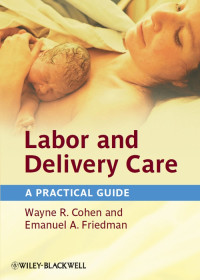
Ebook Labor and Delivery Care : A Practical Guide
The impetus for this book was born of satisfaction and lamentation. We
celebrate the remarkable advances in obstetric care that have occurred
over the span of our careers (encompassing 50 years). We are never
theless troubled by the fact that the burgeoning medical technocracy
has diverted attention from fundamental medical care skills in our spe
cialty, and no doubt in others. The fall in maternal and fetal mortality
and morbidity over the last half-century refl ects in large measure grati
fying advances in obstetric and neonatal technology. Surely the advent
and increasing sophistication of ultrasonography, electronic fetal moni
toring, prenatal diagnosis, antimicrobial therapy, molecular medicine,
and advances in epidemiology have, among others, shaped the form and
substance of obstetric care in ways that have done much to improve out
comes. Residents are now well versed in the complexities and subtleties
of ultrasonography, molecular genetic diagnosis, and immunology; nev
ertheless, relatively few have mastered the essentials of clinical exami
nation and decision making that can make obstetrics so satisfying to its
practitioners and so much safer for its patients. The training of midwives
and physician’s assistants has in its way likewise tended away from the
complexities of clinical assessment.
The recently awakened emphasis on patient safety initiatives in obstet
rics puts this trend in high relief, as much of the focus of these perfor
mance improvement activities has been on improving basic clinical skills.
Moreover, the majority of medical negligence litigation that has pestered
our specialty for decades, reducing the happiness of its practitioners and
its appeal to students, relates to alleged failures in application of funda
mental clinical doctrine. So there is ample justifi cation for a text that
emphasizes our bedrock principles. Within them lie the solutions to many
of our contemporary challenges.
Someday our medical heirs will use anatomic and functional imaging
techniques and laboratory analyses now barely imaginable to evaluate
and diagnose. Skillful physical examination and probing medical history
may no longer be needed or taught. We have not yet, however, reached
the crossroads leading to that brave new medical vale; rather we exist
in a period of transition that requires attention to advanced technologic
approaches as well as to traditional techniques of diagnosis and prob
lem solving. It is with reverence for the latter that we have directed this
volume.
Obstetrics, particularly the management of labor and delivery, has
always been a discipline that requires skilled physical diagnosis in order to
make the most refi ned diagnostic judgments. It demands the synthesis of
several simultaneously acquired lines of diagnostic evidence into a cohe
sive probability matrix in order to balance the risks of intervention and
watchful expectancy. During labor, fetal information (e.g., state of oxy
genation, lie, position, attitude, molding) must be integrated step by step
with facts about the mother (e.g., vital signs, medical condition, uterine
contractility, pelvic architecture) to determine changes in the probability
that a normal vaginal delivery will ensue or that some pharmacologic or
surgical intervention will be necessary to optimize safety. Decisions based
on these changing probabilities obviously require accurate and complete
clinical information to make them reliable. Ideally, that information
should have been demonstrated to be meaningful in appropriate investi
gative studies.
We live in an era of the deifi cation of “evidence-based” medicine. In
fact, evidence-based practice is not new. Good physicians have always
functioned by incorporating the best available scientifi c evidence into
their practice. They have, however, tempered the application of evidence
with sound clinical judgment and the wisdom born of experience and
sapient observation. We ourselves have always emphasized the impor
tance of requiring objective proof whenever possible to justify clinical
interventions. We are, nevertheless, mindful of the fact that not every
thing can be studied with a randomized clinical trial. It is too often unac
knowledged that most of what we do and think is right in medicine has
never been subjected to such investigation. This fact emphasizes the great
value of developing good clinical skills and an in-depth understanding
of the labor and delivery process. From those skills and understanding
derive the obstetric acumen and good clinical instincts that characterize
the best practitioners.
In this volume we have attempted to integrate science and clinical
evaluative arts. We have deemphasized issues related to the application
of electronic technology, such as ultrasound and electronic monitoring,
and focused on the application of good clinical skills and their interpreta
tion. That is not to downplay the value of technology, which is of vital
importance to us; rather, it is done in the service of helping practitioners
establish fi rst-rate clinical skills. We hope the result will prove useful to
anyone privileged to assist women in childbirth.
We are aware of the gender and other biases that tend to populate text
book writing, and equally conscious of (and appalled by) the solecisms,
awkward syntax, and grammatical gymnastics often employed to avoid
them. Throughout this book we have chosen certain default pronouns
and nouns to promote easy reading and ensure uniformity of style. Thus,
we use “she” and “her” when referring to the obstetric practitioner, and
“attendant,” “practitioner” or “provider” for any professional involved in
patient care during labor. Similarly, we use masculine pronouns to refer
to the parturient’s partner in the birth process. Neither these choices nor
the inevitable places in which we have strayed from our best intentions
in this regard are meant to offend.
We are grateful to Martin Sugden and Michael Bevan, our editors at
John Wiley & Sons and their team. Their professionalism, guidance, and
confi dence in the virtues of this project have been immeasurably helpful.
Ketersediaan
| E00011B | 618 | Tersedia |
Informasi Detail
- Judul Seri
-
-
- No. Panggil
-
618
- Penerbit
- West Sussex : Wiley Blackwell., 2011
- Deskripsi Fisik
-
Ebook
- Bahasa
-
Indonesia
- ISBN/ISSN
-
978-0-470-65459-0
- Klasifikasi
-
618.2 COH l
- Tipe Isi
-
-
- Tipe Media
-
-
- Tipe Pembawa
-
-
- Edisi
-
1
- Subjek
- Info Detail Spesifik
-
-
- Pernyataan Tanggungjawab
-
Wayne R. Cohen
Versi lain/terkait
Tidak tersedia versi lain
Lampiran Berkas
Komentar
Anda harus masuk sebelum memberikan komentar
 Karya Umum
 Filsafat
 Agama
 Ilmu-ilmu Sosial
 Bahasa
 Ilmu-ilmu Murni
 Ilmu-ilmu Terapan
 Kesenian, Hiburan, dan Olahraga
 Kesusastraan
 Geografi dan Sejarah